Ask any experienced production manager what keeps them up the night before a large show and there’s a near-universal answer: power. Not the creative brief. Not the client relationship. Not even the weather. Power distribution on a large AV production is the foundational constraint that every other department’s design decisions bump against — and it’s the one element that most clients, creative directors, and show producers understand least until something goes catastrophically wrong.
A History Written in Failures
The live events industry has paid for its knowledge of power distribution with genuine disasters. The 1988 Monsters of Rock stage collapse at Castle Donington, while primarily a structural failure, highlighted the compounding risks of large temporary power infrastructure. More directly instructive was the 2010s wave of generator fires at UK festivals — incidents that pushed Health and Safety Executive (HSE) guidance and Association of Show and Entertainment Technicians (ASET) standards toward mandatory electrical design documentation and qualified electrical supervisor requirements on events above defined scales. These requirements are codified in BS 7909 — the UK standard for temporary electrical systems for entertainment events, with equivalent frameworks in NFPA 70 (NEC) in the US.
The Demand Calculation: Where It Starts
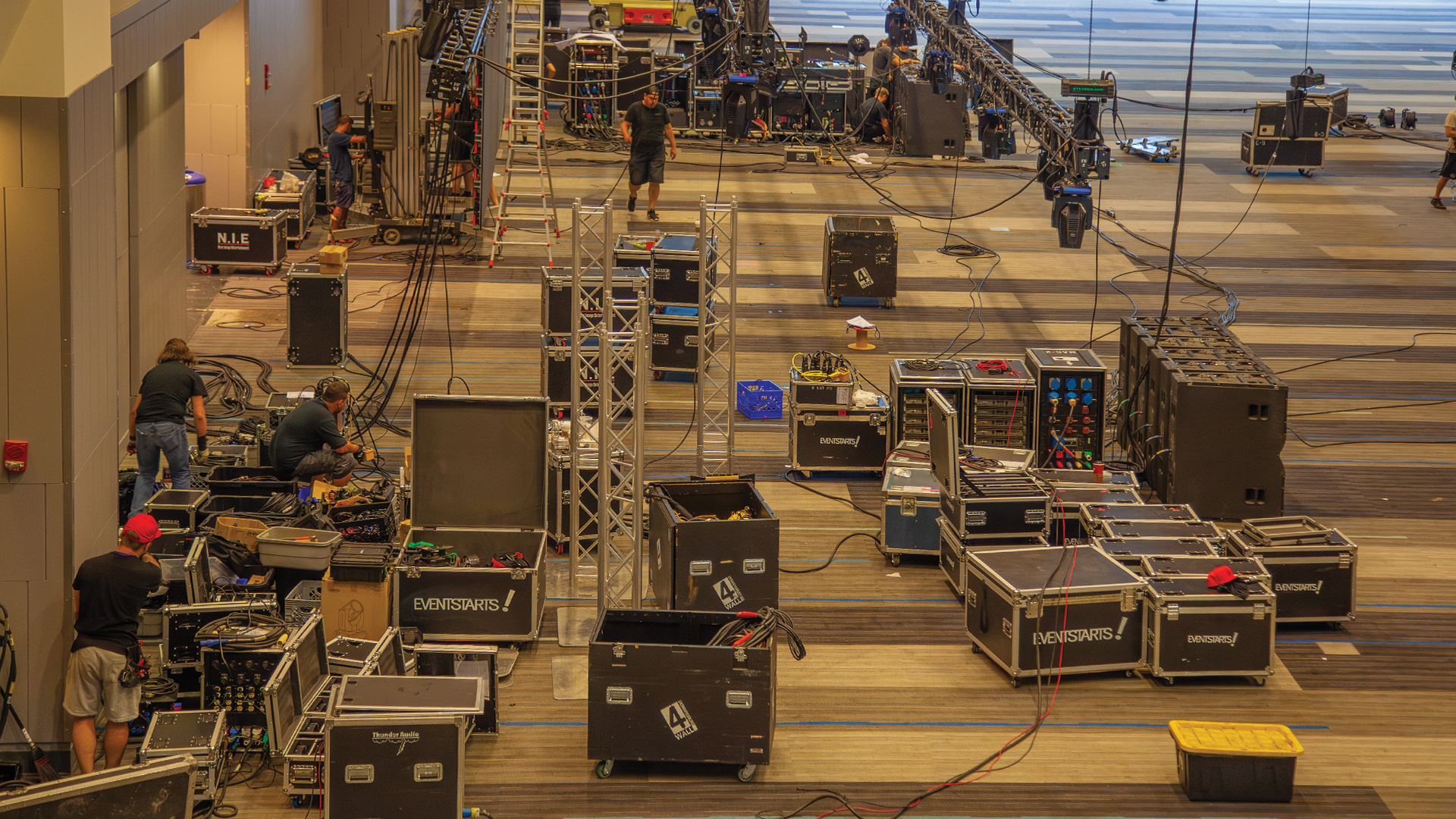
Power planning begins with a load schedule — a complete inventory of every powered device on the production, its rated consumption in watts or kVA, and its duty cycle (continuous vs. intermittent). Lighting departments frequently drive the largest loads: a rig of 100 Clay Paky Axcor 900 Spot units draws approximately 100 kW at full power. Audio amplification for a large festival — L-Acoustics K1 main system with L-ISA processor and LA-RAK amplifier racks — can exceed 150 kW. Video and LED infrastructure adds further significant loads. The total, before venue services, catering, and broadcast, frequently exceeds 500 kW for a major touring production.
The critical distinction in power planning is between peak load and average load. LED lighting rigs have a high inrush current on startup — often three to five times the steady-state running current — that must be accounted for in generator sizing and distribution board specification. A generator sized correctly for average running load may trip its protection devices on startup. This is why load scheduling should always be reviewed by a qualified electrical engineer rather than simply totalling nameplate ratings.
The Distribution Architecture: From Generator to Fixture
Temporary power distribution for events typically follows a layered architecture. A generator set — or connection to a permanent mains supply — feeds a primary distribution board (often a 63A or 125A per-phase three-phase supply). From the primary board, sub-distribution boards feed individual departments. From department boards, local distribution reaches individual fixtures or rack systems. At every level, overcurrent protection — circuit breakers or fuses — and RCDs (Residual Current Devices) provide fault protection.
Companies like Powersafe Distribution, Total Power Solutions, and Lex Products manufacture touring-grade distribution systems — waterproof, road-case-friendly, with Cam-Lok or Powerlock connectors for high-current distribution and a range of CEE-form outlets at department level. The distinction between Cam-Lok (a US standard) and Powerlock (European standard) is a practical compatibility issue on international productions — touring shows that cross continents carry adapter kits, and a mismatched connector on a 400A feed is a dangerous situation to improvise around on site.
Noise on the Line: The Audio Engineer’s Nightmare
Power quality is not purely a safety issue — it’s a signal quality issue. Ground loops, harmonic distortion from SCR dimmer systems, and voltage sags during heavy load switching all introduce noise into audio systems that manifests as hum, buzz, or the characteristic 100 Hz whine of thyristor dimming. The solution is disciplined power separation: audio systems and video systems should be fed from dedicated distribution isolated from dimmer and motor loads. Isolation transformers — from manufacturers like Furman, Ebtech, or Oneac — break ground paths and dramatically reduce coupled noise.
Generator Management: The Operational Layer
Generator-powered productions add the complexity of fuel management, runtime monitoring, and load balancing across three phases. An unbalanced three-phase system — where one phase carries significantly more load than the others — creates neutral current that stresses distribution equipment and may cause voltage imbalance affecting sensitive electronics. Experienced electricians distribute loads across phases during the power schedule design phase, targeting balance within 10% per phase. Power analysers — Fluke 435 or Dranetz HDPQ — provide real-time visibility of phase balance, power factor, and harmonic content during the show.
The Non-Negotiable: Qualified Supervision
The single most important power distribution decision on any large production is assigning a qualified electrical supervisor — a person with appropriate electrical engineering credentials and event industry experience — who takes responsibility for the design, installation, inspection, and operation of the temporary electrical system. Under BS 7909 in the UK, this role is formally defined. In the US, NFPA 70E and local authority requirements specify equivalent responsibilities. The production manager’s job is to ensure this person is on the team from pre-production — not called in at the last minute to sign a form that nobody has read.