The Living Contradiction: Historic Spaces and Contemporary Sound
The professional audio engineer arriving at a commission to install or temporarily deploy a line array system in a historic theater inherits a contradiction that no amount of acoustic engineering fully resolves—only manages with varying degrees of sophistication. The space’s cultural value lies partly in its acoustic character, shaped by centuries of architectural decision-making whose acoustic consequences were intuited rather than calculated. The production’s commercial value depends on delivering audio quality that contemporary audiences expect from a premium event experience. These two requirements pull in opposite directions, and the expertise that bridges them is among the most specialized and commercially valuable in professional AV production.
The 70+ historic theaters where major production companies have formally deployed or installed line array systems in the past decade—venues including the Palais Garnier in Paris, the Teatro alla Scala auxiliary spaces in Milan, the Royal Albert Hall in London, and hundreds of smaller heritage venues across Europe and North America—represent a documented case study in acoustic problem-solving under constraint. Each installation is unique in its specific challenges; all share the fundamental tension between preservation obligation and performance requirement.
Acoustic Measurement First: The Science of Understanding Before Acting
No responsible line array system design for a historic theater begins with a speaker catalog. It begins with a measurement campaign that characterizes the venue’s acoustic behavior with the precision required to inform system design decisions whose consequences cannot be reversed without expensive and disruptive intervention.
The measurement protocol for a historic theater typically involves Rational Acoustics Smaart impulse response measurements at 15–25 positions using a calibrated omnidirectional source—typically a Genelec 8020 or equivalent near-field monitor positioned at the stage center and at multiple other source positions that represent the performance positions the system must serve. The resulting impulse response data reveals the venue’s reverberation time (RT60) at octave bands from 125Hz to 8kHz, its early decay time (EDT), its clarity (C80) and definition (D50) values—the metrics that quantify whether speech and music are intelligible in the space at its natural acoustic conditions.
This measurement data serves two purposes: it provides the inputs for EASE acoustic modeling that predicts system behavior before installation, and it establishes the acoustic baseline against which post-installation measurements demonstrate whether the system has improved or degraded the space’s acoustic properties for natural (unamplified) sound. The latter purpose matters commercially because historic venues operated by preservation-minded building management committees will require evidence that the audio installation has not compromised the acoustic character that makes the space culturally significant.
d&b and L-Acoustics Small-Format Solutions for Constrained Spaces
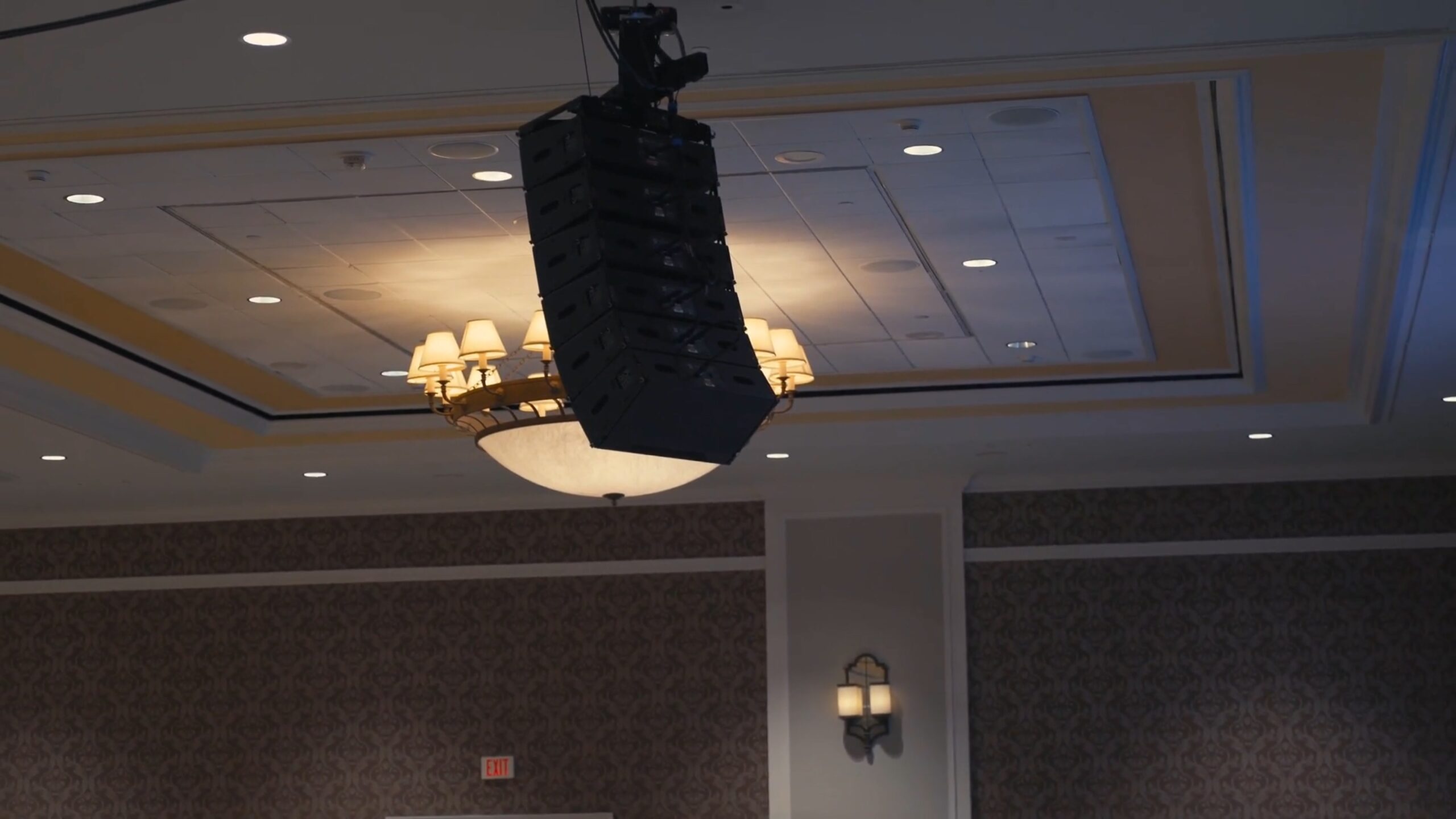
The small-format line array product families from d&b audiotechnik and L-Acoustics have been the dominant solution category for historic theater deployments because their physical size—compact enough for sympathetic installation in architecturally sensitive positions—and their acoustic performance—directivity control consistent with full-scale touring systems—address the twin constraints of historic theater work simultaneously.
D&b’s V-Series line array system (V8 and V12 elements combined with V-SUB subwoofer) delivers the company’s characteristic directivity precision in a cabinet format whose physical dimensions allow installation on ornate proscenium structures, within existing architectural recesses, and on custom-fabricated stands that transfer loads to the structural floor rather than the ceiling—a structural load path that building conservation engineers accept where ceiling-loaded systems are prohibited. The V8’s 90×10 degree nominal dispersion and precise splay adjustment—in 0.5-degree increments via the ArrayCalc simulation—enables coverage of deep, raked seating bowls that historic theaters typically present.
L-Acoustics Kiva II and ARCS Wide compact line array elements have served historic European theater installations from the Opéra de Lyon to the Concertgebouw in Amsterdam in configurations where the system must blend visually with architectural contexts that would reject the aesthetic presence of full-touring format hardware. The Kiva II’s 170×10 degree horizontal dispersion is particularly valuable in wide historic theater formats where a narrow-dispersion system would require additional supplementary fill positions that multiply the visible speaker count in the space.
Structural Engineering: The Non-Acoustic Challenge That Dominates Timelines
The structural engineering challenge of historic theater audio installations routinely exceeds the acoustic engineering challenge in both complexity and timeline impact. A historic theater whose construction predates modern structural engineering—common across European heritage venues built before 1900—may have ceiling and wall structures whose load-bearing capacity was never formally calculated, is not documented in accessible form, and cannot be assumed from visual inspection alone.
The professional response to this uncertainty is independent structural assessment by a chartered structural engineer who understands both the load characteristics of professional audio equipment and the structural conservation principles that govern intervention in listed buildings. This assessment—which may involve ground-penetrating radar to locate hidden structural members, core sampling to determine material strength, and finite element analysis to model load distribution—adds 4–8 weeks to installation project timelines and 5–15% to project budgets. Production managers who don’t plan for it discover it the hard way.
Custom rigging solutions for historic theaters transfer speaker loads to structural elements that conservation engineers accept as intervention points: typically, the structural floor via floor-standing speaker stands engineered for specific load cases, or existing structural columns and arches where load transfer can be achieved without penetrating or permanently modifying historic finishes. Companies specializing in historic venue audio installations—including Arup Acoustics, Sandy Brown Acoustics, and specialist AV installation firms with dedicated conservation project experience—maintain the engineering relationships and documentation precedents that make these structural solutions achievable within acceptable project timelines.
The Temporary Deployment Model: Festival Use of Historic Venues
The temporary deployment model—deploying a touring line array system in a historic venue for a concert series or festival engagement rather than installing a permanent system—presents different challenges from permanent installation but is increasingly the commercial context in which production companies must serve historic venue clients. Temporary deployments must achieve the acoustic performance of a well-designed system, meet the structural constraints of the venue, and be completely reversible within the load-out window—without leaving any mark on the historic fabric.
The temporary rigging systems designed for this context—specifically Prolyte H40V truss used as self-supporting ground support, Liftket electric hoists on beam clamps positioned to distribute load across structural members rather than concentrating it at single points, and custom-fabricated spreader bars that widen the load footprint of rigging points—have been refined through repeated deployment at historic venues into a standardized toolkit that experienced production companies deploy confidently in venues they have never previously visited.
Acoustic optimization for a temporary deployment benefits from the permanent installation literature for the same or acoustically similar venues. The measurement archives that permanent installation projects generate—RT60 data at dozens of positions, EASE model files, post-installation verification measurements—are valuable resources for temporary deployment engineers who can access them, providing the acoustic starting point that accelerates on-site optimization.
Commercial Positioning in the Heritage Market
Production companies that have developed genuine expertise in historic theater audio deployment occupy a niche market position with characteristics that generalist touring production cannot easily replicate. The client base—heritage venue operators, national arts organizations, cultural event promoters—values technical competence and institutional sensitivity in equal measure, and often evaluates suppliers not only on their acoustic credentials but on their track record with building conservation authorities and their reputation within the heritage venue community.
The fee premium that genuine historic theater expertise commands reflects the risk premium that clients are managing: a botched installation at a Grade I listed building or a Category A scheduled monument generates regulatory consequences, reputational damage, and remediation costs that no amount of low-cost production savings can offset. Clients who understand this risk are willing to pay the premium that specialist expertise commands; clients who don’t understand it learn the lesson at whatever production company was willing to underprice the work.
Building a portfolio in heritage audio requires a different development strategy from building a general touring portfolio. The projects are fewer in number, longer in development cycle, and more dependent on institutional relationships—with conservation architects, venue management committees, and arts funding bodies—than on the touring community’s informal network. Production companies that have invested in developing these relationships systematically—attending heritage venue conferences, partnering with conservation architects on early project stages, publishing case studies that demonstrate their understanding of conservation values as well as acoustic performance—have built market positions that their technically equivalent competitors without institutional relationships cannot access.