The distinction between a live event that is filmed and a live event that is broadcast used to be drawn by budget, crew size, and the physical infrastructure of a television production truck. That distinction has been progressively eroded by the democratization of professional broadcast technology into form factors that fit in road cases, check as airline luggage, and can be set up by a two-person crew in under three hours. The modern portable broadcast kit for corporate events represents one of the most significant operational evolutions in live event production — enabling broadcast-quality multi-camera switched programming, live streaming, and recording for corporate clients who demand television production values at event production economics.
Building a portable broadcast kit that delivers consistently and reliably across diverse event environments requires thoughtful component selection, disciplined system design, and the operational experience to know which compromises are acceptable and which are not. This is not about buying the cheapest gear that technically works — it is about engineering a system that performs under the specific pressures of corporate event production: compressed setup timelines, demanding clients, environments optimized for the live audience rather than camera coverage, and the absolute requirement that the stream or recording does not fail during the keynote address.
Camera Selection: The Core of the System
The camera package defines the visual standard of the broadcast output and must balance image quality against portability and operational flexibility. For corporate event broadcast, the dominant professional choices are Sony PXW-Z280, Canon XA Series, and Panasonic AU-EVA1 for compact operator cameras, with Sony FX6, Blackmagic Pocket Cinema Camera 6K Pro, or Canon EOS R5 C for cinema-quality capture when the budget and post-production pipeline supports it. For a portable broadcast kit, prioritize cameras with SDI output — the industry-standard interface for professional video infrastructure. Consumer cameras with HDMI-only output introduce signal integrity vulnerabilities (HDMI connectors are not designed for repeated connect/disconnect cycles) and require additional conversion hardware that adds cost, complexity, and failure points.
The Production Switcher: Nerve Center of the Broadcast
For portable broadcast applications, the production switcher must balance functionality with physical footprint. The Blackmagic Design ATEM Mini Extreme ISO has become a fixture in portable corporate broadcast kits — a remarkable convergence of switcher, multiviewer, audio mixer, and ISO recording in a single unit smaller than a laptop. For higher-end applications, the ATEM 2 M/E Production Studio 4K, Ross Video Carbonite Black, or NewTek TriCaster TC1 provide the mix-effects architecture, downstream keyers, and media player capabilities of broadcast switchers in rack-mountable packages that travel in standard road cases.
The NewTek TriCaster deserves particular mention in the history of portable broadcast production. When TriCaster launched in 2006, it was marketed explicitly as a “television studio in a box” — combining switching, graphics, recording, and streaming in a single integrated system that a solo operator could transport and deploy. It represented a genuine democratization moment for portable broadcast, making multi-camera switched production accessible to a market that had previously required a production truck to achieve equivalent functionality.
Audio Integration: The Underinvested Component
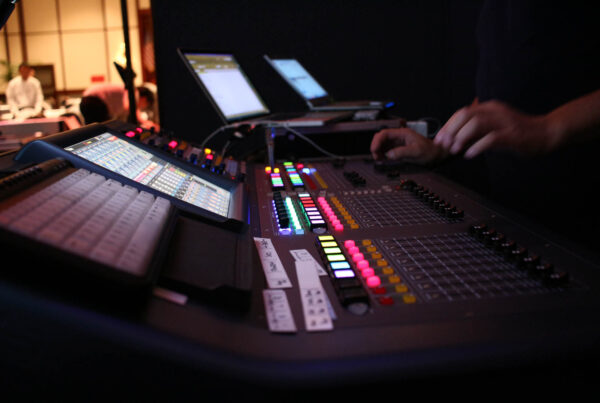
Broadcast audio quality is consistently the most underinvested component of portable corporate broadcast kits — and the most immediately audible quality differentiator between amateur and professional production. For broadcast-quality audio, the kit requires a dedicated audio console or audio interface — even if the production switcher has audio mixing capability, that capability is typically designed for broadcast monitoring, not primary mix engineering. A Yamaha AG series, Behringer X32 Compact, or Allen & Heath Qu-16 provides proper gain staging, EQ, compression, and effects processing for broadcast audio that the switcher’s built-in mixer cannot match.
The broadcast audio feed must be derived from the front-of-house console — specifically a matrix output or direct out feed configured for broadcast levels, not from a house speaker feed or room microphone. Work with the event’s A1 to establish a broadcast mix bus in the FOH console — a separate mix that can be optimized for the broadcast audience’s listening environment (typically louder, with more compression and presence boost than the live room mix) and fed directly to the broadcast kit’s audio input via balanced XLR at line level.
Encoding, Streaming, and Recording: The Output Stage
The output stage of a portable broadcast kit must handle three simultaneous functions: live encoding and streaming, program recording, and ISO camera recording for post-production edit delivery. Dedicated hardware encoders from Haivision Makito X, LiveU Solo, and Teradek VidiU Go provide hardware-accelerated encoding with lower latency and more reliable performance than software-based solutions. For recording, Atomos Shogun series, Blackmagic HyperDeck Studio, and the ISO recording capabilities of ATEM Extreme ISO provide solid-state recording on standard media formats that edit workflows can ingest without conversion.
The Portable Kit Road Case Design
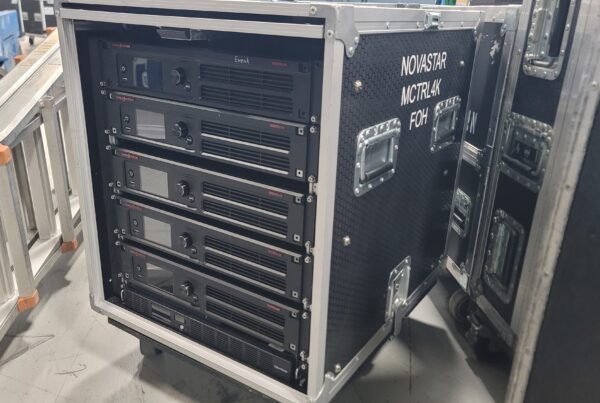
A portable broadcast kit is only portable if its packaging enables rapid, safe transport and efficient deployment. Design the road case architecture around operational zones: a control case containing the switcher, audio console, and monitoring; a connectivity case containing distribution amplifiers, converters, and patch infrastructure; a power case with UPS modules and power distribution; and individual camera cases with lens and accessory organization. Label every case with its contents, its weight, and its position in the setup sequence. A portable broadcast kit that can be fully operational in 90 minutes by a two-person crew — and that has been designed and rehearsed to that standard — is a genuine competitive differentiator in the corporate event production market.