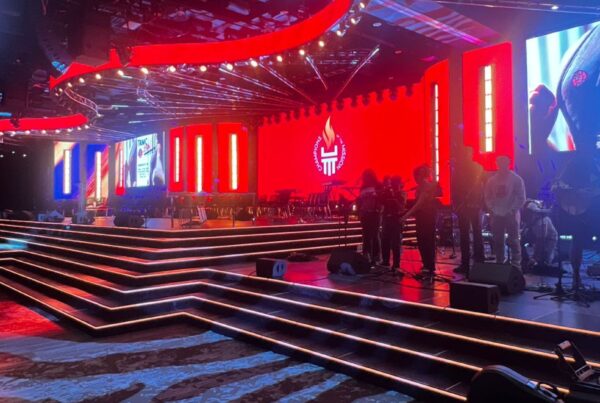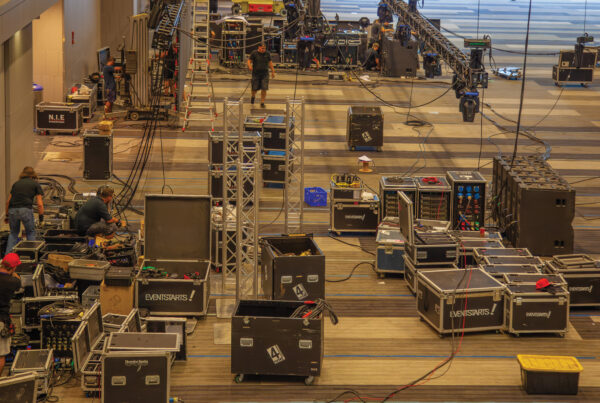
The overnight LED wall rebuild is among the most logistically complex and physically demanding operations in live event production. It occurs when a large-scale LED installation must be completely struck, transported or reconfigured, and re-erected in a different configuration or location within a single overnight window — typically the 10–12 hours between the end of one event and the start of the next. It is common in arena conference productions where the day’s general session must transform into an awards gala setting, in multi-city touring productions where truck-freight walls must be re-deployed on a 24-hour cycle, and in broadcast productions where studio sets change overnight between episodes. Executing an overnight LED wall rebuild without structural failure, visual quality degradation, or crew safety incidents requires systems, planning, and leadership of a very high order.
Pre-Build Planning: The Blueprint That Saves Hours
Every minute saved during an overnight rebuild was earned in pre-production planning. The rebuild blueprint — a document specifying the exact sequence in which panels are struck, transported, and re-erected — is the operational bible of the overnight. It must specify: the panel strike sequence for the existing installation, identifying which panels can be removed first without compromising the structural integrity of the remainder; the transportation configuration — which panels go in which cases in which order on which truck; the re-erection sequence for the new configuration; and the systems check procedure before handoff. The blueprint should be developed in consultation with the structural engineer (for the physical sequencing) and the video systems engineer (for the data and power topology of the new configuration), not drafted unilaterally by the production manager.
Crew Sizing and Shift Design
Overnight rebuilds create the most acute version of the crew fatigue problem. A team that builds and operates a full show through the afternoon and evening, then continues into an overnight rebuild, is physically and cognitively compromised for the most safety-sensitive tasks of the rebuild by the time they reach them. The responsible approach is shift separation: a show crew that operates the event and is dismissed at strike, and a rebuild crew that begins fresh when the show crew’s work is complete. This model requires explicit handoff briefing — a 15–20 minute meeting between outgoing and incoming crew leads where the state of the system, any anomalies observed during the show, and the specific requirements of the rebuild are communicated. Productions that attempt overnight rebuilds on a single continuous crew without shift separation consistently produce lower-quality re-erections and higher injury rates than those that build a proper shift structure into the production budget.
Panel Tracking and Case Management
LED panels on a rebuild must be individually tracked to ensure that the right panel goes back to the right position in the new configuration. On colour-calibrated walls — where individual panels have been matched for colour and brightness uniformity — mixing panels between positions produces visible calibration mismatches that require time-consuming recalibration to correct. Panel barcode labeling or RFID tagging — with a manifest linking each panel’s serial number or label to its designated new position — enables systematic rebuild verification. Case layouts designed for the specific rebuild configuration — with panels pre-sorted into cases by their new installation position — dramatically accelerate unloading at the new build site. Staging areas in the venue must be pre-designated and marked before the rebuild crew arrives, so panels arrive at their final installation position without intermediate sorting steps.
Power and Data Topology Changes
When an LED wall changes configuration — from a flat wall to an angled panel layout, from a single screen to a split multi-screen design — the power distribution and data topology of the new configuration must be documented and tested independently of the previous configuration. Reusing power and data cabling from the previous installation without verifying that it matches the new topology is one of the most common sources of overnight rebuild failures. Pre-drawn data topology diagrams — showing exactly which processor output connects to which panel chain in the new configuration — must be prepared in pre-production and be physically in the hands of the systems engineer during the rebuild. Colour-coded data cables by processor output — a simple investment in cable management — allow the re-patching process to be completed quickly and verified visually without the cognitive overhead of interpreting unlabeled cables under time pressure at 3am.
The Systems Check Before Handoff
An overnight LED wall rebuild is not complete until a full systems verification has been conducted and signed off by the video systems engineer. The systems check must include: full brightness test on white at maximum operating level, looking for dark pixels, hot spots, and brightness uniformity; colour sweep through primary and secondary colours at multiple brightness levels; content playback through the media server at the actual show resolution and frame rate; and structural inspection confirming that all cabinet connections are fully secured and all panels are correctly seated. This check must be completed and documented before the event production team takes over the space — not during their setup time. Any issues discovered during the systems check must be resolved before handoff, not deferred to be managed during the next event’s rehearsal period.
Case Studies in Overnight Rebuild Efficiency
The techniques for rapid overnight LED wall rebuilds have been refined primarily in the trade show and corporate events markets, where modular LED systems are routinely struck and rebuilt across back-to-back multi-day conferences. Companies like George P. Johnson, Freeman, and Czarnowski have developed proprietary build sequencing methodologies, custom case systems, and specialist wall crew training programs that allow overnight rebuilds of installations that would take a general crew twice the time. The investment in this institutional knowledge — captured in procedures, training, and specialized equipment — is the accumulation of thousands of overnights of practical experience that cannot be replicated by reading a technical specification sheet.