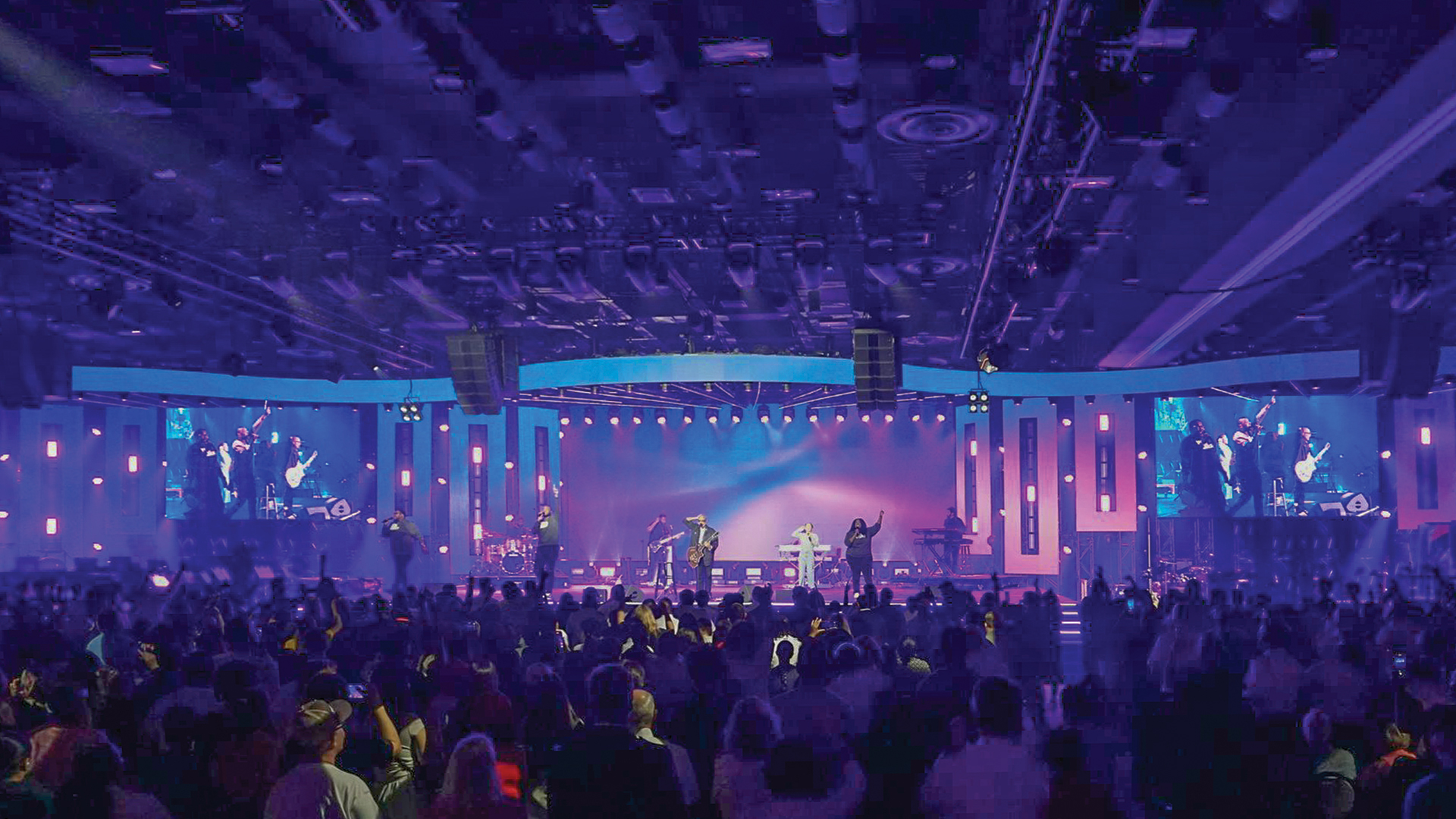
Curved LED walls have become one of the defining scenic statements of contemporary touring and corporate event design. From the sweeping concave curves of a stadium stage to the intimate convex arc of a corporate event backdrop, curved LED architecture creates a three-dimensional visual field that flat walls simply cannot replicate. The challenge is that content designed for a flat screen renders with spatial distortions on a curved wall that range from subtly wrong to visually incoherent — making proper content preparation for curved installations one of the most technically specialized skills in live event video production.
Understanding the Geometry of Curved LED Installations
A curved LED wall is not a single flat canvas — it is a series of flat tile modules positioned at progressive angles to each other to approximate a curve. Understanding the actual geometry of the installed wall is the essential first step in content preparation. The production designer or video director must obtain from the scenic or staging company the precise angular specification of the wall: the radius of curvature, the total arc angle (typically expressed in degrees), the tile-to-tile angle step, and the horizontal and vertical pixel count of the assembled system. These parameters directly inform how content must be designed and processed.
Warping and Blending in Media Server Platforms
Professional media server platforms include native tools for managing curved output geometry. Disguise’s d3 platform uses a mesh warp editor that allows the operator to define the physical geometry of the LED wall as a 3D surface and then project content onto that surface using perspective-correct rendering — compensating for the angular distortion that would otherwise be visible as stretching on the outer sections of a curved wall. Resolume Arena’s Advanced Output Transformer and Green Hippo Hippotizer Karst’s Geometry Correction module offer similar capabilities for less complex curved installations.
Content Design Rules for Curved Surfaces
Content teams that understand curved wall physics design their assets differently from the outset. Text and graphics with strong horizontal lines — which would appear perfectly straight on a flat wall — take on a subtle barrel or pincushion distortion on a curved surface depending on the curvature direction and the viewing angle. Experienced AV content directors at companies like Moment Factory and Treatment Studio design for curved walls using pre-distorted canvas sizes in After Effects and Cinema 4D, intentionally distorting horizontal elements in the opposite direction so they appear straight to the audience when viewed on the curve.
LED Processor Configuration for Curved Outputs
The LED processor — Brompton Technology Tessera or Novastar MCTRL series — must be configured to correctly map the pixel output to the physical tile layout of the curved wall. On a simple single-curve installation this involves configuring the receiver card addresses and cabinet layout in the processor software to match the physical tile arrangement, but on complex multi-curve or wave installations, the tile layout may require custom cabinet grouping configurations that go beyond the processor software’s default mapping templates. Commissioning curved LED installations correctly requires both the media server operator and the LED processor technician to collaborate on output geometry from the earliest pre-production stage.
Physical Viewing Angle and Brightness Compensation
On a concave curved wall, the center of the wall faces the audience more directly than the edges, which are angled away. This geometry means that the center sections receive more direct line-of-sight illumination and appear brighter to the audience than the outer edges at identical driving levels. High-end LED processors including Brompton Technology’s Tessera platform support per-cabinet brightness and color calibration that can compensate for this angular viewing phenomenon, ensuring consistent luminance uniformity across the full arc of the wall as perceived from the front-of-house audience position.