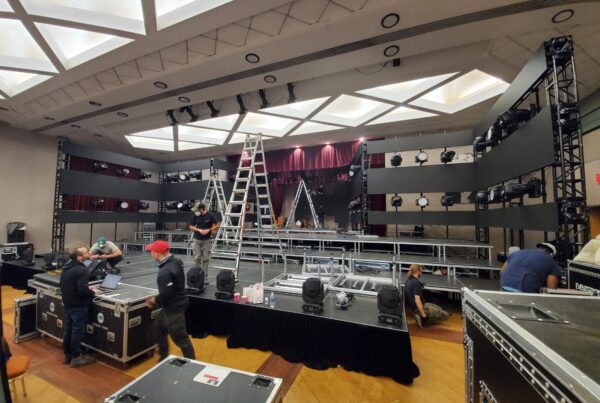
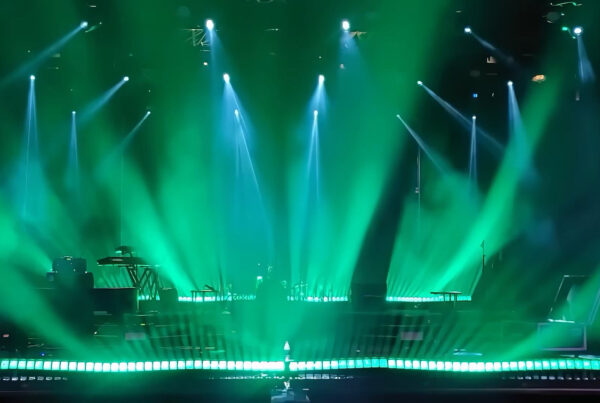
LED video panels are supposed to display content—graphics, IMAG feeds, brand messaging—with consistent color and brightness across entire surfaces. When they misbehave, they do so with theatrical flair: single panels going rogue with different content, entire rows developing distinctive color casts, and occasionally the entire wall deciding that random patterns are more interesting than programmed material.
Understanding LED Panel Architecture
LED video walls comprise modular panels—typically 500mm square units from manufacturers like ROE Visual, Absen, or Unilumin. Each panel contains receiving cards that interpret video signal, driver chips controlling LED current, and hundreds or thousands of individual LED packages mounted on circuit boards.
This architecture creates multiple potential failure points. A receiving card failure might cause a panel to display frozen content, wrong content, or nothing at all. Driver chip issues can affect specific pixel regions. Individual LED failure creates visible dark spots within otherwise functional panels.
The Evolution of LED Video Technology
Large-format LED displays evolved from stadium scoreboards of the 1980s. Early systems used discrete red, green, and blue LED packages spaced inches apart—adequate for viewing at hundreds of feet but unusable for closer applications. The development of SMD (Surface Mount Device) LEDs enabled tighter pixel pitches.
Modern fine-pitch LED achieves pixel pitches below 1mm—the Sony Crystal LED reaches 0.63mm, creating displays suitable for close viewing. This miniaturization introduced new failure modes: thermal management became critical as densely packed LEDs generate significant heat, and manufacturing variations that were invisible at large pitches became obvious at fine pitches.
Spectacular Panel Failures
The most memorable LED panel misbehavior I’ve witnessed occurred at a product launch. The company had invested in a massive ROE Visual Carbon CB5 wall displaying carefully designed animations. During the CEO’s keynote, a single panel in the center of the wall began displaying content from the previous cue—frozen on the company’s logo while surrounding panels showed the new product.
Troubleshooting revealed a loose fiber optic connection to that panel’s receiving card. The card had lost sync with the Brompton processor feeding the wall and defaulted to displaying cached content. The fix took thirty seconds once identified, but those thirty seconds stretched across several minutes of prominent malfunction during the event’s highest-profile moment.
Color and Brightness Inconsistency
LED panel matching presents ongoing challenges. LEDs from different manufacturing batches may have slightly different color points. Professional rental companies maintain lot-controlled inventory—panels from the same manufacturing run stay together to ensure visual consistency.
Aging affects matching over time. As LEDs operate, their output gradually shifts—typically losing brightness while color point drifts. A wall assembled from panels with different usage hours may display visible variation. Calibration systems from Brompton Technology and Colorlight can compensate, but only within limits.
Signal Path and Processing
Many LED panel problems originate in signal processing rather than panels themselves. Media servers like Disguise, Resolume, and Notch generate content that flows through video processors before reaching panels. Problems anywhere in this chain manifest as panel misbehavior.
Resolution mismatches cause scaling artifacts. Color space conversions can shift appearance. Frame rate inconsistencies create visible tearing or judder. Experienced video engineers trace signal paths systematically when troubleshooting, isolating whether issues originate in content, processing, or display.
Prevention and Preparation
Preventing LED panel disasters begins with thorough pre-production. Every panel should be individually tested before installation. Full-wall content playback reveals matching issues invisible in single-panel testing. Spare panels—typically 10-15% of wall count—should be on-site for rapid replacement.
Signal redundancy protects against processing failures. Running parallel video feeds through separate processors allows instant switchover if primary systems fail. Some installations implement automatic failover that detects signal loss and switches sources without operator intervention.
The LED panels that misbehave dramatically remind us that video walls are complex systems masquerading as simple displays. Behind every seamless image lies intricate coordination of electronics, software, and signal distribution—all vulnerable to the entropy that affects every technical system. When that coordination breaks down, the breakdown happens at scale, in front of everyone, with no possibility of hiding the failure.