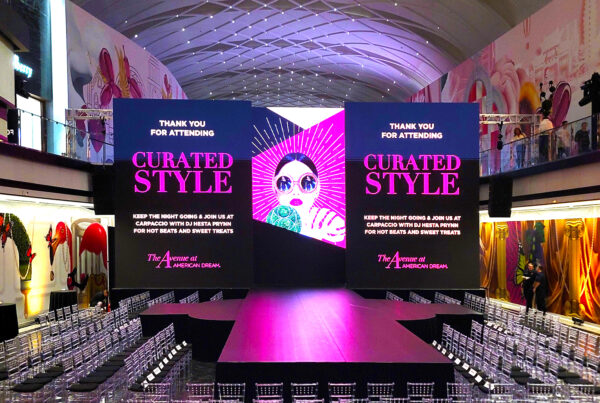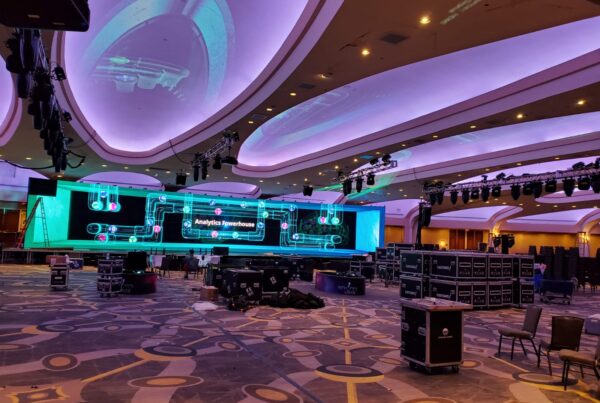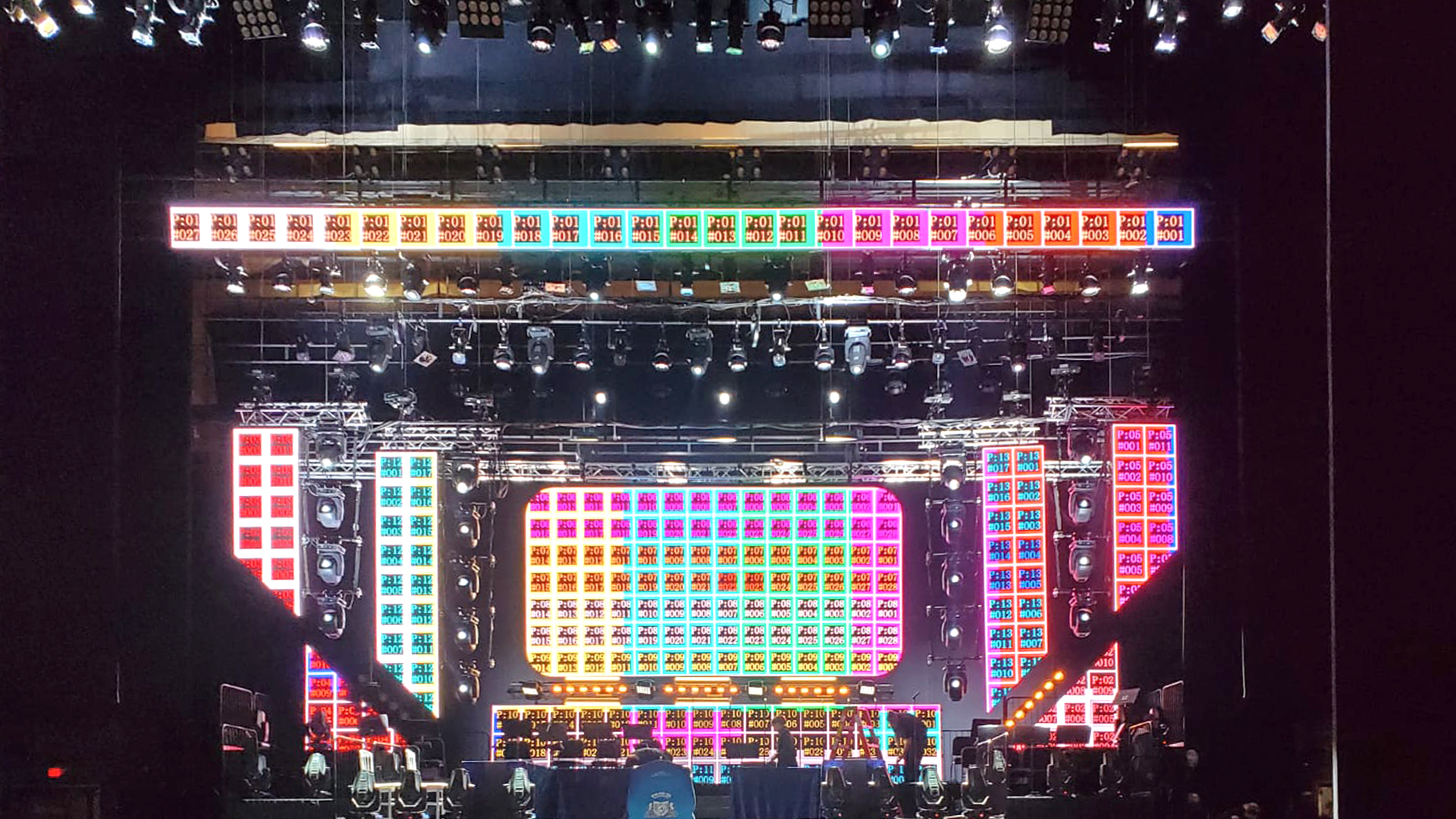
LED floors and interactive touchscreen installations have become signature elements of high-end live productions, experiential marketing events, and broadcast entertainment formats. The visual spectacle they create for the live audience is undeniable. Capturing that spectacle on camera is a discipline that requires every member of the production team — camera, lighting, video, and content — to understand a set of optical and electronic challenges that apply uniquely to self-luminous floor surfaces and interactive displays.
The Refresh Rate Problem
Every LED display operates at a refresh rate — the frequency at which the image is redrawn on the surface. Broadcast cameras shooting at 25fps or 29.97fps sample the display at a rate that does not align with the screen’s refresh cycle, producing rolling scan lines or flickering bands in the captured image that are invisible to the human eye but prominent on camera.
The solution is to match the LED panel’s scan rate to the camera’s shutter speed. For cameras shooting at 25fps with a 1/50 second shutter (the standard 180-degree shutter rule), the LED panel should be set to a minimum refresh rate of 3840Hz. High-end LED flooring systems — Absen Floor Series, ROE Visual Vanish V8, StageSmartLED — offer variable refresh rates up to 7680Hz specifically to address this broadcast requirement.
Colour Shift and Viewing Angle
Cameras shooting LED floors at oblique angles must contend with the off-axis brightness roll-off of the panels. The difference in apparent brightness between the near edge and the far edge of a floor panel can be 2-3 stops of exposure, creating an exposure gradient that the camera’s auto exposure system cannot resolve. Manual exposure control and content brightness compensation — designing the content brighter at the far edge — are both required to manage this challenge.
Moire Interference Patterns
The interaction between a camera sensor’s pixel grid and an LED panel’s pixel pitch produces moire interference patterns — a rippling, shimmering artefact that is particularly prominent when cameras with full-frame sensors — Sony FX9, Canon EOS R5, Blackmagic Pocket 6K — shoot fine-pitch LED panels. Mitigation strategies include choosing a panel with a pixel pitch significantly finer than the camera’s sensor resolution, and using a diffusion filter — Tiffen Black Pro-Mist 1/4 or Schneider Hollywood Black Magic — in front of the lens.
Content Design for Camera Capture
Content displayed on LED floors must be designed with camera capture in mind from the earliest creative stage. Content with large areas of saturated white will overexpose the camera in any shot that includes a performer on the surface, while very dark content will make the performer’s legs disappear into the surface. The production sweet spot is mid-tone content with directional light simulation. Real-time generative content systems like Notch Builder and TouchDesigner allow content that responds to performer position tracked by depth sensor arrays including Microsoft Azure Kinect and Intel RealSense — creating interactive effects that follow performers across the floor.
Camera Movement on LED Floor Productions
Camera operators who must work on the LED surface itself should wear dark, non-reflective clothing to minimise their visual footprint in wide shots, and should coordinate movement with the content operator to avoid creating shadow artefacts during key performance moments. Dolly systems and robotic track systems — Chapman/Leonard, TechnoCrane, Moviebird — that run on perimeter tracks outside the LED surface maintain freedom of movement without introducing shadows.