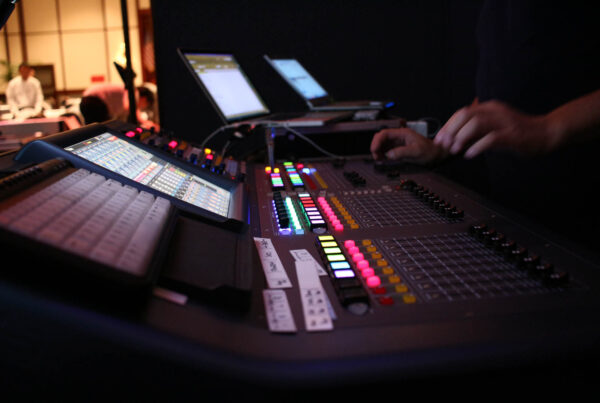
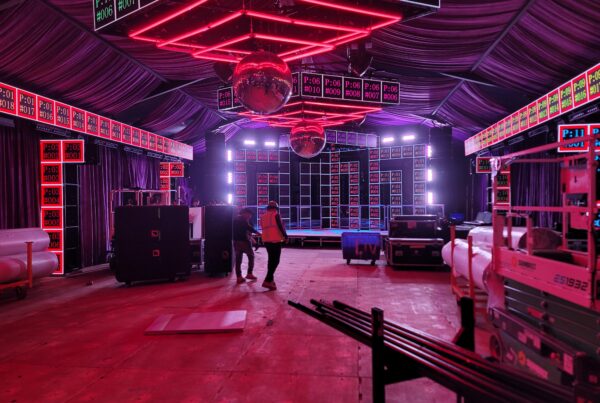
A live broadcast with 20 or more cameras is not simply a large-scale version of a three-camera production. It is a fundamentally different operational environment — one in which the director is making cutting decisions from a gallery of monitors that presents more simultaneous visual options than the human brain can process, in which the camera operators are executing precise moves that must coordinate with the lighting and visual environment, and in which the LED wall behind the performers is simultaneously serving the live audience in the room, the broadcast viewer at home, and the technical requirements of two dozen different camera angles. LED wall mapping that successfully guides 20+ cameras in live broadcast is one of the most demanding technical achievements in the contemporary live event industry.
The 20-Camera Environment: Why Scale Changes Everything
The production workflows for broadcast LED wall mapping at 20+ camera scale are not simply scaled-up versions of smaller productions. They require pre-production planning disciplines — camera blocking integration, perspective calibration workflows, and content architecture decisions — that have no equivalent in smaller broadcast productions or conventional live event productions. The director of photography at a 20-camera broadcast operates with a storyboard that anticipates the visual composition of every camera angle relative to the LED environment, ensuring that no camera position encounters a visual presentation that was not considered in the content design. The technical director manages a signal routing matrix that can assemble any combination of camera feeds, LED content outputs, and graphic overlays in real time — a capability that requires a Grass Valley Korona or Ross Video Acuity production switcher with sufficient input count to handle the full camera complement.
Camera Position Calibration: The disguise Workflow
The disguise media server platform’s camera-matching workflow is the professional standard for LED wall mapping in multi-camera broadcast productions. The process begins in pre-production with the import of the physical stage geometry and camera positions into the disguise three-dimensional environment, establishing the spatial relationship between the LED wall’s pixel grid and each camera’s perspective. At the production venue, a calibration process — using reference markers placed on the LED wall and identified through each camera’s live feed — corrects the theoretical pre-production model for any discrepancy between the planned and actual camera positions. The output of this calibration is a set of per-camera perspective correction parameters that the disguise server applies to the content rendered for each output, ensuring that graphical elements designed to appear at specific compositional positions in the broadcast frame appear at exactly those positions regardless of which of the 20 cameras is cutting live.
Broadcast Format Standardization: 4K, HDR, and the LED Wall
The transition of major broadcast productions to 4K UHD and HDR (High Dynamic Range) delivery has created new requirements for the LED wall systems serving as broadcast environments. 4K cameras reveal pixel structure, moire patterns, and color uniformity variations in LED panels that are invisible at 1080p resolution, raising the specification threshold for broadcast-grade LED to pixel pitches of 2.6mm or tighter for walls that appear prominently in the broadcast frame. HDR delivery requires that the LED wall’s luminance range — the ratio between its maximum white output and minimum black level — is sufficient to represent genuine visual dynamic range in the broadcast encode. Brompton Technology’s Tessera SX40 processing with PureTone™ calibration provides the per-pixel color calibration precision that ensures an LED wall can achieve the color accuracy and luminance consistency that HDR broadcast standards require.
Real-Time Camera Tracking Integration
The most advanced 20-camera LED broadcast productions integrate real-time camera tracking data directly into the LED content engine, allowing the visual environment to dynamically adapt to each camera’s current field of view. Systems like Mo-Sys StarTracker and Ncam Technologies provide real-time tracking data — position, orientation, focal length — for each camera on the production, transmitted to the disguise media server via a low-latency network connection. The server uses this data to render a perspective-correct version of the LED content for each camera’s current position, so that three-dimensional visual elements appear to exist in actual space rather than as flat displays. This technique — the foundation of virtual production in film and television — is increasingly applied in live broadcast environments, with The Voice, American Idol, and Eurovision Song Contest productions incorporating versions of the technology in recent seasons.
The Director’s Toolbox: What 20-Camera LED Broadcast Requires
The broadcast director managing a 20-camera LED production operates with an expanded toolbox that conventional broadcast directors don’t encounter. The ability to change the LED wall content in real time — from the gallery, via a control interface integrated with the production switcher — means that the director can respond to unexpected performance moments by updating the visual environment rather than simply selecting a camera angle. Clearcom Eclipse HX digital matrix intercom systems link the director with the disguise operator (who manages content changes), the lighting director (managing the fixture environment), and the LED systems engineer (monitoring the wall’s technical performance) through dedicated broadcast station positions in the gallery. The coordination between these roles across 20 cameras and multiple simultaneous technical systems is what makes a broadcast LED production of this scale appear effortless to the viewer.
Case Study: The BRIT Awards, The O2 Arena
The BRIT Awards ceremony at the O2 Arena in London represents one of the best-documented examples of 20+ camera LED broadcast mapping in the European entertainment industry. The production — broadcast live to approximately 3-4 million UK viewers and a substantial international audience — deploys a LED stage environment that changes completely for each performing artist, with the LED wall mapping system required to perform reliably through 12-15 major stage transitions during a 3-hour live broadcast. Production designer Misty Buckley’s designs for the BRIT Awards stage environments have consistently employed LED wall configurations that create complete visual worlds for each performance, with content produced by specialist studios including Moment Factory and UnitedVisuals. The broadcast is managed by ITV’s technical team from the Lorraine OB truck complement, using disguise media servers for LED management and Grass Valley production switching for the camera infrastructure.
The Future: Automated Content Adaptation for Any Camera
The trajectory of LED wall mapping technology for multi-camera broadcast production points toward increasing automation of the perspective calibration and content adaptation workflows. Machine learning systems that can identify camera positions from their video feed — without requiring physical calibration markers — are in development at multiple technology companies active in the virtual production space. Disguise’s ongoing investment in their Extended Reality (XR) platform — which provides a complete virtual production framework built on the same architecture as their concert touring LED products — suggests that the workflows developed in Hollywood virtual production will continue to migrate into live event and broadcast LED applications. The point at which a director can deploy 20 cameras in any configuration and have the LED wall automatically adapt its content mapping to each camera’s perspective in real time — without pre-production calibration — is likely within the current technology generation’s development horizon.
AV Production Insights | Professional Series