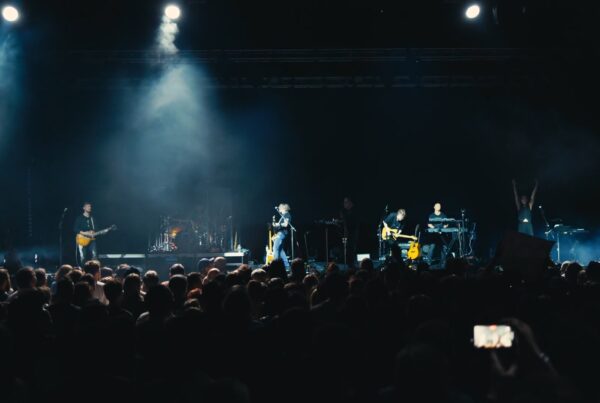
The story of live touring sound is, in many ways, the story of JBL Professional. From the earliest arena tours of the 1970s to today’s globally synchronized festival circuits, JBL’s engineering heritage has carved the acoustic blueprint that the entire industry now follows. When crews talk about what touring sound reinforcement should feel like — that chest-resonating low-end, the crystalline high-frequency shimmer at 120 metres from the stage — they are describing a standard largely defined by JBL’s half-century of field innovation.
The Origins: From Hollywood Bowls to Concert Halls
JBL’s concert lineage traces back to founder James Bullough Lansing, whose 1946 loudspeaker designs rewired how engineers thought about transducer efficiency. By the late 1960s, Bill Hanley — widely credited as the godfather of concert sound — was deploying early JBL components at events like the 1969 Woodstock Festival. That 400,000-person gathering exposed every limitation in the era’s PA system design and simultaneously proved that scale-capable reinforcement was achievable. Hanley’s towers, loaded with JBL drivers, became the prototype for everything that followed.
Through the 1970s, touring crews for Led Zeppelin, The Rolling Stones, and Pink Floyd were specifying JBL-loaded cabinets custom-built by sound companies including Clair Brothers and Showco. The JBL 4560 bass cabinet and the 2360 horn became fixtures on backstage manifests before the term ‘backline’ even entered common usage.
The Line Array Revolution and JBL’s Defining Role
The real seismic shift came in the 1990s when line array technology began replacing the scattered cluster systems that had dominated arena touring. V-DOSC by L-Acoustics demonstrated the physics of coherent cylindrical wavefront propagation, but it was JBL’s own answer — the JBL VerTec series, launched in 2000 — that brought scalable line array performance to the touring mainstream at a price point rental companies could absorb.
The VerTec VT4889 became arguably the most widely deployed touring line array element of the 2000s. It toured with artists from Metallica to Beyoncé, filled stadiums in São Paulo and Singapore, and survived conditions — blazing desert heat, monsoon-soaked outdoor stages, sub-zero European winter tours — that would have destroyed lesser enclosures. Production crews began specifying it not because it was the only option, but because its reliability-to-performance ratio was unmatched in the rental inventory.
JBL VTX: The Modern Benchmark
When JBL launched the VTX Series in 2012, the company did something rare in pro audio: it rendered its own best-selling product obsolete by choice. The VTX V25 line array introduced Differential Drive technology — dual voice coils on a single former — delivering 160 dB maximum SPL with reduced distortion across the touring frequency spectrum. Paired with the VTX S28 subwoofer, the system created a bottom octave that stadium mixing engineers described as ‘finally catching up to the mains.’
JBL’s HiQnet System Architect software and later Crown I-Tech HD amplification platforms made the VTX system networkable at scale — an essential requirement for modern multi-stage festival deployment where a single engineer might supervise audio across four simultaneous performance areas. The ability to recall, monitor, and adjust system parameters from a tablet walking the festival grounds represented a production workflow transformation.
Landmark Deployments That Shaped Best Practice
Certain JBL installations have entered production lore as reference case studies. The 2014 FIFA World Cup opening ceremony in São Paulo saw over 200 VTX V25 elements arrayed across the Itaquerão stadium, engineered by Ampco Flashlight with system design by Bob McCarthy — one of the industry’s foremost system optimisation specialists. The coverage uniformity achieved across 68,000 seats, despite the stadium’s asymmetric architecture, became a benchmark cited in JBL application training globally.
Equally defining was the Ed Sheeran Mathematics Tour of 2022–2024, which utilised JBL VTX systems across 580 shows on six continents. Production company Britannia Row Productions specified the system for its consistent low-frequency throw and the absence of inter-element coupling artifacts that plague lesser arrays in open-air environments. The tour’s audio director, Niall Slevin, credited the VTX platform’s consistent performance as central to delivering the same listening experience whether in a 5,000-seat theatre or an 80,000-capacity stadium.
Why These Deployments Still Matter
Understanding historic JBL deployments isn’t nostalgia — it is the practical archaeology of modern touring production. Every decision made today about hang angle calculation, subwoofer cardioid configuration, and amplifier-to-cabinet impedance matching has a lineage traceable back to crew decisions made on VerTec rigs in the early 2000s. The engineers who cut their teeth on those systems — now heading audio departments at the world’s largest production companies — built their intuition on JBL enclosures.
The tools have grown more sophisticated. Prediction software like JBL Line Array Calculator II and the broader EASE Focus ecosystem now pre-visualise coverage before a single cable is terminated. But the underlying acoustic principles, the engineering philosophy of controlled directivity, and the premium placed on intelligibility over raw volume — those are the inheritance of five decades of JBL touring deployments. For any production professional entering this industry, knowing this history is not optional. It is the foundation on which every professional judgment is built.