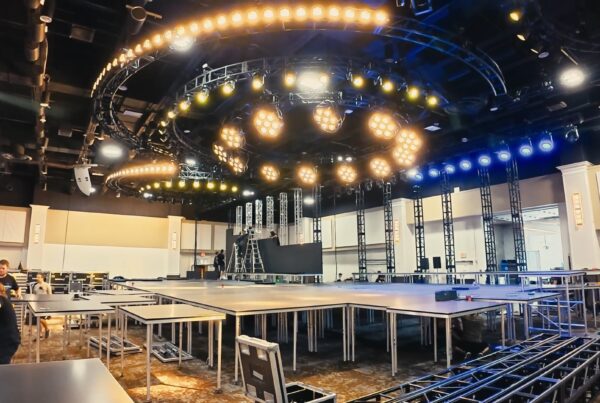
The 24-hour turnaround show is the production industry’s equivalent of a Formula One pit stop — a precisely choreographed exercise in controlled urgency where every minute of inefficiency has a direct cost. Whether you’re striking a corporate gala and rebuilding for a product launch in the same ballroom, or turning over a festival stage between headline acts, the difference between a smooth handover and a catastrophic delay almost always traces back to decisions made days before the crew set foot on site.
The Psychology of Compressed Timelines
Before any technical discussion, acknowledge the human factor. Crews working 24-hour turnarounds face genuine cognitive performance degradation after the 16-hour mark that no amount of coffee compensates for. Research by the National Institute for Occupational Safety and Health consistently shows that error rates on complex technical tasks increase by up to 70% after 18 hours of continuous work. This is not a character flaw — it’s physiology, and production managers who ignore it pay for it in equipment damage, safety incidents, and re-work costs.
The professional response is structured crew rotation. Divide the team into a Strike Crew and a Build Crew with a deliberately planned overlap window of 90 minutes where both teams are on site simultaneously. The outgoing crew completes the heavy work while they still have energy reserves; the fresh crew absorbs site context and begins prep work before the baton is fully passed.
Pre-Production Documentation That Actually Gets Used
A 24-hour turnaround lives or dies on its documentation quality. The strike/build bible — a comprehensive pack that every department head carries — should include a flyover schedule (a minute-by-minute timeline from first truck on dock to show-ready), colour-coded rigging plots that distinguish between retained elements and struck elements, and a power distribution map that identifies which circuits can be left live during the strike phase and which must be de-energised.
Software tools like Vectorworks Spotlight and AutoCAD allow production designers to produce overlaid plots showing the outgoing rig and incoming rig in a single document — an invaluable reference that reduces decision-making on the fly. Printing this at A1 and pinning it at the production office and loading dock is low-tech but highly effective.
Rigging and Structural Reconfigurations
The highest-risk phase of any 24-hour turnaround is the rigging reconfiguration — the period when motor loads are changing, truss is in motion, and the space is simultaneously occupied by both a strike team and the early arrivals of the build crew. IRATA-certified riggers should be the only personnel on the ground directly beneath active picks, and a dedicated rigging supervisor should have sole authority over load movements during this phase — no exceptions for production pressure.
Motor choreography is where time is won or lost. Pre-programming the Lodestar CM motor controller or Movecat Smart Drive system with the trim heights for both the outgoing and incoming rig eliminates the manual calculation that slows down rigging departments on otherwise well-managed turnarounds. Store the incoming show presets in a secondary memory bank on the controller so they’re available immediately when the strike is complete.
Audio System Resets
Audio is frequently the department that causes the most delay in a turnaround scenario because it is the most sensitive to system verification requirements. You cannot just plug in a d&b audiotechnik Y-Series line array and go — every rigged system needs a signal chain check, a delay time verification against the room geometry, and a limiter confirmation pass before anyone trusts it with live content.
Pre-building and pre-testing subarray and fill speaker packages in the dock — performing the Lake LM 44 Controller configuration on a bench rather than at height — dramatically reduces verification time once the system is flown. Audio departments who invest in Smaart v9 or SysTune real-time analysis tools during the build can complete a full system transfer function check in under 20 minutes per zone, versus the 45-minute process that characterises less-prepared teams.
Lighting and Video Reset Protocols
Lighting departments on tight turnarounds should build to standardised patch conventions — consistent DMX universe assignments and fixture numbering schemes across both shows allow the lighting programmer to reuse console infrastructure and address only the creative differences between the two events. The GrandMA3 showfile structure should be partitioned so that the physical output configuration is a separate component from the creative content — this allows a full rig change while preserving the incoming show’s programming.
LED video walls present a particular challenge in turnarounds because cabinet alignment — achieving a visually seamless tiled surface — cannot be rushed without creating visible moiré artefacts or brightness inconsistencies across the panel boundary. The Brompton Technology Tessera processor’s Per-Panel Calibration feature applies stored calibration data to each individual panel, meaning a wall that was calibrated during the build can be struck, rebuilt, and re-calibrated to match its original state in a fraction of the time required for a first-time setup.
Catering, Communication, and Culture
The production details that the spreadsheet misses are frequently the ones that determine whether a crew rises to a 24-hour challenge or crumbles under it. Hot food at the 12-hour mark is not a luxury — it is a performance investment. A production that provides a proper crew meal mid-turnaround will receive noticeably sharper focus and better decision-making in the final hours than one that leaves teams foraging for vending machine calories.
Radio communication discipline is equally critical. On a compressed timeline, the production manager becomes the information hub for eight departments simultaneously. Using a channelled radio protocol — with separate channels for rigging, audio, lighting, video, and logistics — prevents the cross-talk that consumes critical decision-making time. Platforms like Motorola MOTOTRBO with digital trunking allow priority override for the production manager’s voice, ensuring critical instructions cut through departmental traffic.