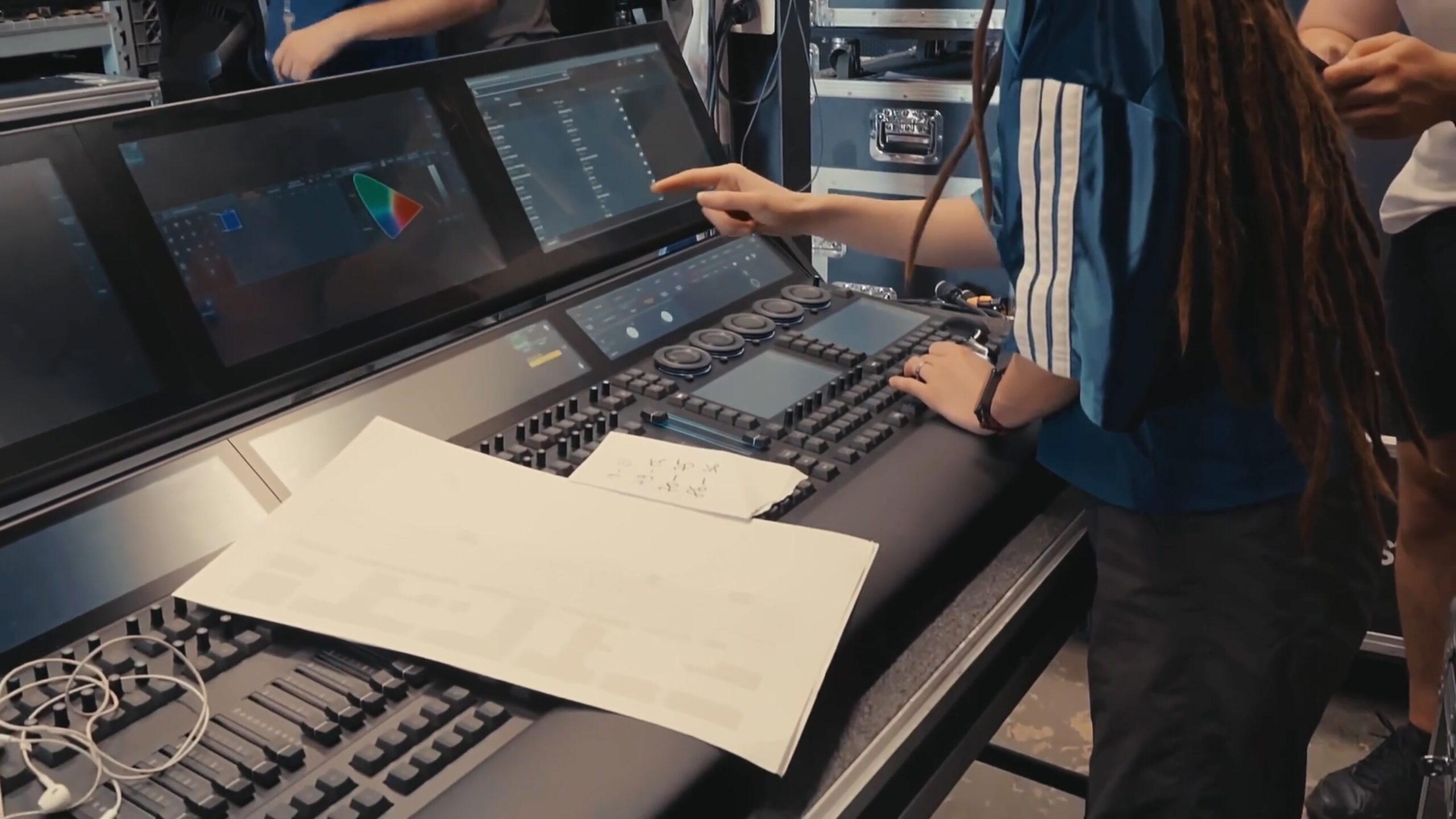
In the history of professional stage lighting, few products have achieved the market dominance of the grandMA3. Walk into any major festival lighting control position worldwide and the probability of finding a MA Lighting console exceeds 80%—a market share that reflects not just product quality but the network effect of a generation of lighting programmers who learned their craft on MA hardware. The grandMA2 system, launched in 2006, established the operational paradigm that the grandMA3 inherited and extended, creating a console ecology so deeply embedded in festival culture that it functions as the industry’s lingua franca.
The statistics are stark: 1,500+ major festival shows per year globally are programmed and operated on MA platforms. From Tomorrowland in Belgium to Fuji Rock in Japan, from Coachella in California to EDC Las Vegas, the grandMA3 full-size or grandMA3 light occupies the lighting operator position at headline-level productions with a consistency that borders on monopoly.
The MA3 Architecture: What Makes It Different
The grandMA3 system’s power lies in its object-oriented programming architecture. Unlike older console paradigms that stored lighting states as simple channel-level snapshots, MA3 organizes information into a hierarchy of presets, sequences, cue lists, and executors—a structure that allows complex shows to be built from reusable building blocks that can be updated globally with a single value change.
The MA3 networking architecture supports MA-Net3 and Art-Net 4 protocols, with each system capable of managing over 250 universes of DMX natively. At a festival with multiple stages, each with its own lighting rig, the MA3’s Session architecture allows multiple consoles to share a common data pool while maintaining independent control surfaces—a multi-operator workflow that enables the main stage designer and the second stage designer to work simultaneously without data conflicts.
MA3’s internal fixture library—containing thousands of fixture profiles maintained by MA Lighting and the community-driven GDTF (General Device Type Format) standard—eliminates the manual profile-building that consumed hours of programmer time on legacy systems. Modern fixtures from Robe, Claypaky, Martin Professional, and GLP arrive on the grandMA3 as fully-defined objects, with attribute ranges, virtual color mixing, and gobo indexing pre-configured.
Cue List Strategy for Multi-Act Festival Productions
Programming a festival lighting system differs fundamentally from programming a single-artist tour. A festival lighting programmer must create cue lists that serve the visual language of 20+ different acts across a multi-day event, using a shared rig that will be reconfigured—at most—once between the end of load-in and the final act’s breakdown.
The professional approach involves building playback structures that give guest lighting designers maximum flexibility without requiring them to understand the entire show file architecture. At headline festivals, the house lighting programmer creates a base show file containing the complete rig patch, fixture groups, position presets, and color palettes—a template against which each touring LD can layer their show programming, either pre-loaded before the festival or programmed on site during advance sessions.
MA3’s Timecode integration—typically receiving SMPTE LTC or MTC from a Yamaha QL5 or DiGiCo SD console via MIDI or AES67—enables music-synchronized lighting sequences where specific cue triggers are married to exact beat positions within a track. EDM festivals like EDC and Ultra deploy timecode systems for headline electronic acts whose lighting shows are as precisely choreographed as their setlists, with MA3 executors firing at sub-frame accuracy to synchronize strobe effects with snare transients and beam movements with melody phrases.
Programmer Techniques That Define Professional Shows
The gap between a competent grandMA3 operator and a world-class festival programmer lies in technique depth that formal training rarely covers. One of the most powerful—and least discussed—techniques in MA3 programming is Tracking versus Block cueing strategy. In tracking mode, attribute values persist from cue to cue unless explicitly changed—a behavior that makes cue lists efficient to program and modify but dangerous if misunderstood. A programmer who doesn’t account for tracking behavior can unknowingly corrupt the visual output of cues that appear correct in isolation but carry unexpected attribute states from earlier cues.
MA3’s Fixture Groups system enables programming efficiency that compounds across a large festival show file. Creating groups based on geometric position—upstage wash, mid-truss beam, downstage beam—rather than manufacturer type allows a programmer to access any subset of the rig intuitively, regardless of fixture count or type mix. Top-tier festival programmers maintain group structures with 50–100 groups in standard deployments, giving them the granular rig access needed to create dynamic, varied lighting looks without hunting through individual fixture selections.
The Effects Engine in grandMA3 has grown sophisticated enough to replace custom programmer-built effects for most touring applications. MA3’s effects—Sine, Random, Spline, and the custom user-defined waveform editor—allow programmers to create complex chase patterns, tilt-and-pan circles, color runs, and intensity flickers as parametric functions rather than hard-coded cue sequences. The advantage is instant scalability: an effect programmed for 32 beam fixtures automatically scales to 64 when additional fixtures are added to the selection.
Network Infrastructure: The Backbone of Festival Lighting
A grandMA3 system at a major festival is only as reliable as the network infrastructure supporting it. The standard deployment architecture uses gigabit Ethernet with managed switches—typically Cisco Catalyst or Luminex GigaCore—configured with IGMP snooping and dedicated VLANs for MA-Net3 traffic, Art-Net output, and RDM management. Separating these traffic types prevents the multicast flooding that can cause dropped packets and lighting glitches during high-activity show moments.
Grandmaster redundancy is non-negotiable at festivals where a console failure mid-show is unacceptable. MA3’s Session Backup architecture allows a second grandMA3 console to mirror the primary session in real time, taking over within seconds of detecting a primary console fault. At major productions, the backup console sits at a position visible to the operator with a dedicated monitor showing session sync status—a quiet but critical insurance policy against the hardware failures that will eventually affect any electronic system over a long touring cycle.
The future of MA Lighting integration points toward MA-Net3’s deeper compatibility with GDTF and MVR (My Virtual Rig) formats, enabling seamless workflow from pre-visualization in MA3D or Depence software through to live show operation without the manual re-patching that has historically added hours to festival advance sessions.
Historic MA Moments That Shaped the Industry
The grandMA platform’s history is punctuated with productions that redefined what festival lighting could achieve. The 2012 Super Bowl halftime show featuring Madonna—directed by lighting designer Al Gurdon—used grandMA2 systems to coordinate 2,800 fixtures across a performance that reached 114 million viewers, demonstrating the MA platform’s broadcast integration capability at the highest possible production level.
Metallica’s World Magnetic Tour (2008–2010)—one of the highest-grossing rock tours in history—deployed grandMA systems to control a rig of 1,200+ fixtures that included the iconic “death clock” LED installation above the stage. The programming team, led by Rob Koenig, created a show file that balanced pre-programmed timecode sequences with real-time operator control, allowing the lighting design to respond to the band’s characteristically variable live performances without sacrificing the cinematic precision of the pre-programmed sequences.
These landmark productions didn’t just showcase the grandMA’s capability—they attracted a generation of lighting designers to the MA platform, creating the skill concentration that today makes grandMA3 expertise the defining credential in festival lighting production.