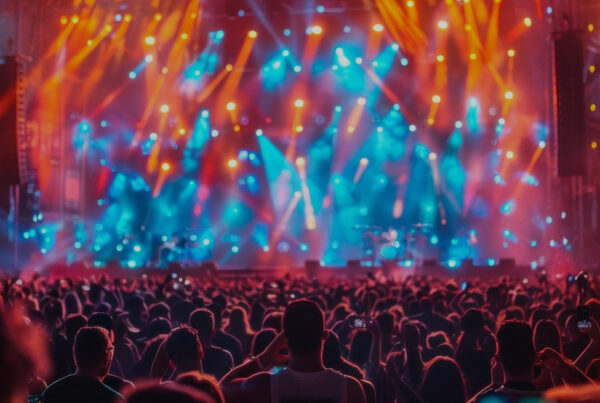
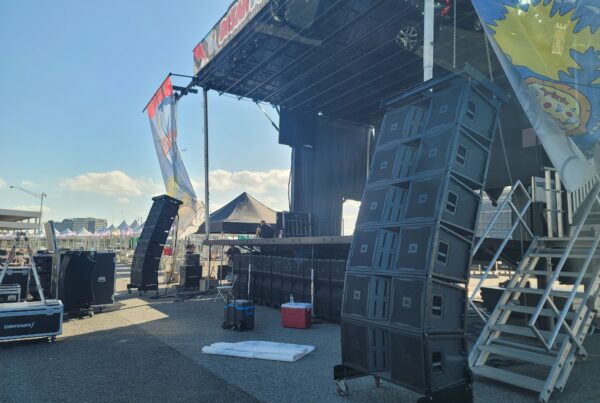
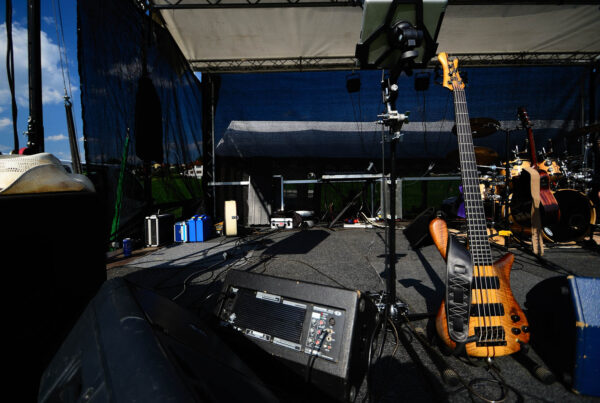
Few brand names carry the same weight in professional live sound as JBL Professional. Since Bill Thomas and Jim Lansing founded James B. Lansing Sound in 1946, JBL has been woven into the fabric of nearly every genre of amplified music and every format of live performance. In the festival landscape of 2024, JBL VTX touring systems continue to define what festival-grade audio sounds like — from the thundering sub-bass of an EDM stage to the nuanced mid-frequency articulation demanded by acoustic folk sets on a boutique festival’s second stage.
JBL’s Legacy in Live Sound
The story of JBL in live sound is inseparable from the story of rock and roll itself. JBL transducers appeared in the monitor systems at Woodstock in 1969, inside the Altec-powered stacks that pumped sound across Max Yasgur’s farm to half a million people. Through the 1970s and 1980s, JBL’s 4530 bass reflex cabinets and 2445 compression drivers became standard components in touring rigs operated by companies like Showco and Maryland Sound. When JBL Professional launched the VerTec line array series in 2000, it represented one of the most significant transitions in festival audio — from point-source stacks toward true J-frame line array technology that would eventually become the global touring standard.
The VTX Series: Engineering for Every Genre
The current JBL VTX product family represents the culmination of nearly eight decades of transducer engineering. The VTX A12 — a compact, high-output line array element — has become a workhorse for mid-scale festival deployments, particularly where rigging weight restrictions prevent the deployment of larger systems. The VTX A8 fills secondary stages with astonishing coverage uniformity, while the flagship VTX V25-II handles the acoustic demands of 60,000-capacity main stages. What makes these systems particularly well-suited to festival environments is the integration with JBL’s Performance Manager software — a system configuration and optimization platform that calculates rigging angles, subwoofer cluster configurations, and delay timing for auxiliary speaker positions, all within a single workflow.
EDM Applications: SPL, Headroom, and Sub Integration
Electronic dance music presents arguably the most demanding SPL requirements of any live music genre. A festival main stage EDM act can demand peak SPL levels of 110–114 dB(A) at the front-of-house mix position, sustained across sets that run for 90 minutes or more. In this environment, amplifier headroom and thermal protection become existential concerns. JBL’s Crown iTech 12000HD amplifiers — developed in partnership with JBL’s parent company Harman — provide 12,000 watts of Class-D amplification with DSP-based loudspeaker management built in. When paired with JBL VTX S28 double-18-inch subwoofers in cardioid end-fire configurations, EDM productions achieve the extended low-frequency impact that genre audiences demand — felt at 25Hz and below — without compromising the intelligibility of vocals and melodic content above 200Hz.
Rock Productions: Midrange Articulation and Stage Dynamics
Rock and roll has always been about midrange aggression — the growl of an overdriven guitar, the crack of a snare drum, the chest-cutting clarity of a lead vocal cutting through a wall of noise. JBL VTX systems address this with dedicated waveguide technology that controls horizontal dispersion precisely in the 1kHz–8kHz range — exactly where guitar and vocal energy lives. FOH engineers working with major rock acts on VTX systems cite the D2 dual-diaphragm driver as a key differentiator, providing a smooth, fatigue-free top end that allows mixes to sustain SPL without listener fatigue — a concern that sound engineers managing 2-hour rock productions take very seriously.
Pop Productions: Broadcast Quality in a Live Environment
Pop festival productions in 2024 blur the line between concert and broadcast event, with multi-camera OB trucks, IMAG screens larger than the stages themselves, and livestream audiences in the tens of millions. In this environment, PA system audio quality must satisfy both the live audience SPL requirement and the exacting sonic standards of broadcast capture. Productions using JBL VTX systems with BSS Audio signal processing — another Harman brand — report excellent compatibility with broadcast audio chains, particularly when using the Soundweb London BLU-806 as a system-level DSP router, distributing processed audio feeds from the main PA simultaneously to monitors, delay fills, and broadcast matrix outputs.
Competing at the Top: JBL Against d&b and L-Acoustics
The premium touring sound market is fiercely contested between JBL Professional, d&b audiotechnik, and L-Acoustics. Where d&b’s GSL and SL-Series systems compete on predictive accuracy and preinstalled calibration, and L-Acoustics K Series wins loyalty through the French brand’s premium touring culture, JBL’s competitive advantage lies in the depth of the Harman ecosystem — amplification, signal processing, drive software, and transducer technology all developed under one engineering roof. For large-scale festival productions managing complex multi-stage systems with limited crew time, that ecosystem integration is often the deciding factor in a system rental tender.