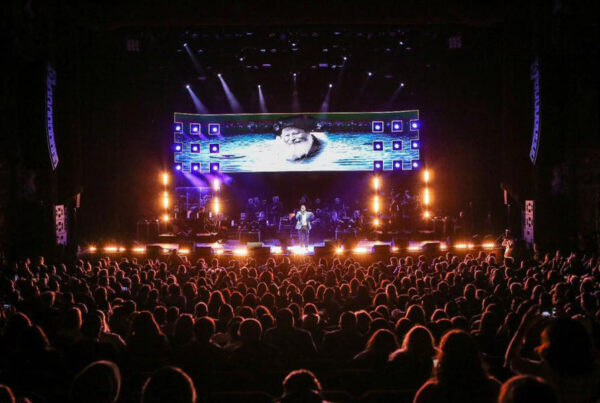
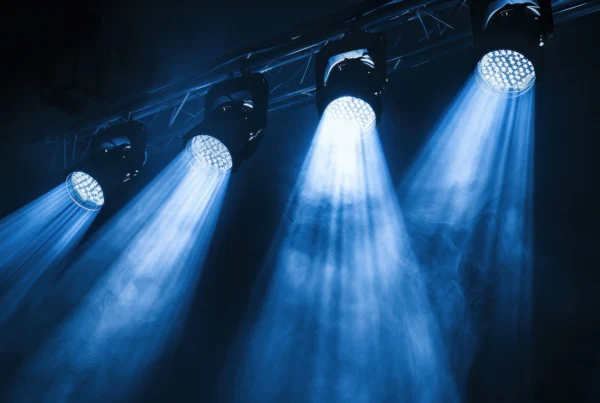
Walk into any major EDM festival stage enclosure — whether it is the main stage at Tomorrowland in Boom, Belgium, the mainstage at Ultra Music Festival in Miami, or the colossal Electric Daisy Carnival main stage in Las Vegas — and there is a significant probability that the system processing your carefully engineered four-on-the-floor kick drum is built on JBL Professional technology. The company’s dominance in the global festival audio market is not accidental; it is the product of seven decades of acoustic engineering evolution combined with a commercial infrastructure that allows JBL to deploy and support systems simultaneously across dozens of global tour dates and festival productions.
A Brief History: From Movie Theaters to Festival Main Stages
JBL — James B. Lansing Sound — was founded in 1946 by James Bullough Lansing, whose earlier work at Altec Lansing had produced the loudspeaker technology that served as the audio infrastructure for Hollywood’s transition to sound film. The company’s trajectory from studio monitors and cinema systems to concert PA systems accelerated through the 1970s as rock concerts evolved from gymnasium-scale events to stadium productions demanding speaker systems capable of reaching 100,000 people. The JBL 4300 series studio monitors shaped the sound of recorded music throughout the 1970s and 80s, while the touring division’s VerTec line array system — introduced in 2002 — established the company’s first major footprint in the large-format touring audio market and directly addressed the shift from conventional trapezoidal cabinet stacking to controlled-dispersion line array technology.
VTX: The System That Changed Festival Audio
The JBL VTX Series — specifically the VTX V25 and subsequently the VTX V20 and VTX A12 — fundamentally repositioned JBL in the high-end touring market. The VTX V25, launched at the 2013 InfoComm trade show, was designed from first principles using Computational Fluid Dynamics (CFD) modeling of the acoustic waveguide — a methodology previously applied in aerospace engineering but novel in professional loudspeaker design. The result was a high-frequency waveguide that maintained consistent pattern control across the full operating bandwidth without the high-frequency beaming and off-axis coloration that had limited earlier-generation touring systems. For EDM production specifically, the extended low-frequency output of the VTX V25-II — capable of reaching 37 Hz without supplemental subwoofers in dense array configurations — addressed a critical gap in festival audio: EDM’s characteristic subsonic and low bass content that was routinely lost or distorted by systems designed for rock program material.
JBL VTX and the Festival Circuit: Documented Deployments
The festival deployment record for JBL VTX systems reads like a map of global electronic music culture. Tomorrowland’s Mainstage has deployed VTX V25 and VTX V20 systems across its signature castle stage design since 2016, with the system’s horizontal coverage adjusted annually to accommodate the evolving stage geometry that is rebuilt from scratch each July. Creamfields in the United Kingdom — one of Europe’s longest-running dance music festivals — has used JBL VTX arrays on its Main Stage continuously since 2014, with production supplier SSE Audio managing the system builds. Sensation, the Amsterdam-based white-dress event concept that has toured globally across 30 countries, deployed JBL VTX V25-II as its primary PA for productions including the 2019 Ziggo Dome shows, where the system’s uniform coverage pattern served the arena’s challenging 360-degree audience configuration.
Crown Infrastructure: The Amplification Backbone
JBL VTX systems do not operate in isolation — they are designed as integrated systems with Crown Audio I-Tech HD series amplifiers providing the power infrastructure. The Crown I-Tech 12000HD — the amplifier most commonly associated with VTX touring deployments — delivers 6,000 watts per channel into 4 ohms and incorporates IQwic network management and PIP2 processing modules that handle speaker management, delay, EQ, and protection functions without external DSP hardware. This integrated architecture reduces rack space, simplifies system setup, and enables the JBL HiQnet Performance Manager software to monitor and control every amplifier channel in a festival system — potentially hundreds of channels spread across multiple amplifier racks — from a single laptop at the system engineer’s position. At Electric Daisy Carnival, where the main stage system regularly exceeds 400 amplifier channels, this centralized management capability is not a convenience feature; it is an operational necessity.
The EDM Frequency Challenge: Designing for Electronic Music
Electronic dance music presents PA system designers with a frequency distribution challenge unlike any other live music genre. The genre’s characteristic 808 kick drums, tuned to 40-60 Hz, demand subwoofer extension and output that tests the limits of even premium touring systems. The build-up and drop structure — long gradual tension builds resolving into intense SPL peaks — creates dynamic range demands that exceed those of virtually any other live music format. JBL’s VTX S25 and VTX S28 subwoofers, specified in cardioid end-fire configurations for EDM festivals, are deployed in arrays of 24 to 48 cabinets per system position to achieve the 130+ dB SPL consistently demanded by the genre’s production specifications. Hardwell, Martin Garrix, David Guetta, and Tiësto — all artists whose production teams have specified JBL VTX systems on their primary touring riders — routinely use the system’s extended low-frequency response to deliver bass content that the audience feels physically rather than simply hears.
DSP and Tuning: The Science Behind the Sound
The raw hardware of a JBL VTX deployment is only as effective as the DSP tuning that optimizes it for each specific venue and event. JBL’s HiQnet Performance Manager incorporates proprietary Differential Drive technology — a transducer design that uses multiple voice coils driven by separate amplifier channels to extend excursion capability without increasing cabinet size — and provides prediction-to-reality comparison tools that allow system engineers to verify that measured performance matches the pre-show simulation. For EDM festivals specifically, system engineers routinely apply dynamic EQ curves that compress the 80-120 Hz region during the loudest moments — protecting the system from over-excursion while maintaining perceptual loudness balance. This tuning methodology, refined over hundreds of festival deployments, is what separates a system that sounds correct from one that merely sounds loud.
The Competition and the Standard: Where JBL Stands Today
JBL VTX does not own the EDM festival market without competition. L-Acoustics K2 and K1 systems, d&b audiotechnik J-Series, and Martin Audio MLA each hold significant festival market share. But JBL’s combination of technological innovation, global service infrastructure through its parent company Harman International (now a Samsung subsidiary), and the commercial infrastructure to support simultaneous deployments on six continents has established a market position that competitors acknowledge openly. The company’s investment in the VTX A-Series — optimized specifically for festival-scale productions — and the new VTX B-Series subwoofers announced at InfoComm 2024 suggest that the system that defines EDM festival audio will continue its evolution at the pace the genre demands.
AV Production Insights | Professional Series